Panelled Composite Doors
Traditional four and six-panel detail.
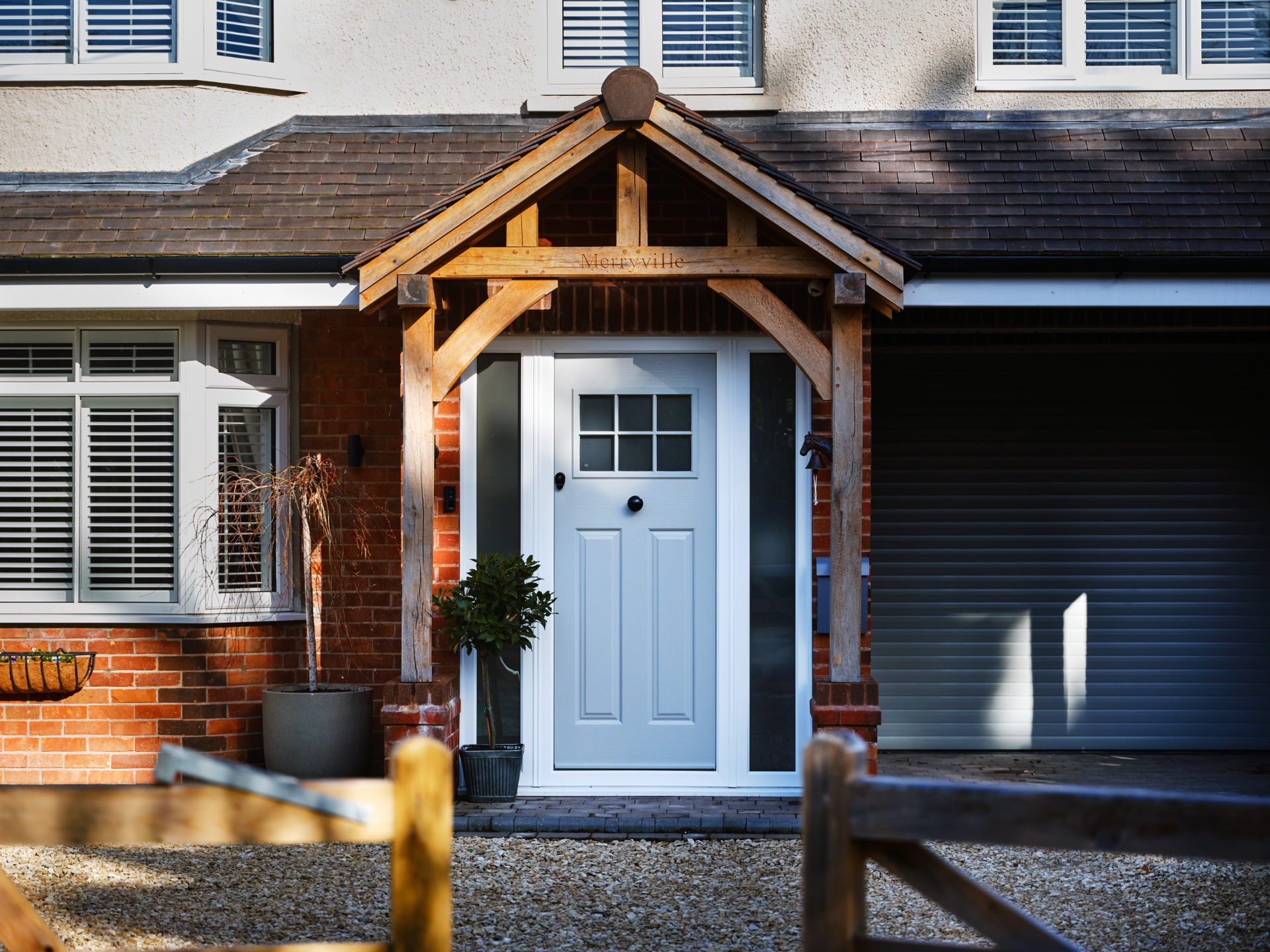
Panelled composite doors keep the four-panel and six-panel raised-mould detail that Cornish homeowners recognise from Victorian, Edwardian, interwar and post-war housing stock — but built as maintenance-free composite construction that will not warp, split or need repainting. Panelled is one of the two dominant style categories across the county (flush being the other), and it covers the middle ground between fully-traditional heritage specifications and modern minimalist arrangements.
We install panelled composite doors as the most-common replacement specification on the many Cornish terraced, semi-detached and detached properties built between 1900 and 1970 with original panelled timber doors. The panel arrangement is chosen to match the property era — six panels for Victorian and Edwardian, four panels for interwar and post-war.
Typical price
£1,395–£1,895
Fully installed, 10-year guarantee
Want a quick price?
Free survey, no salesman, no obligation.
Where panelled composite doors suit.
- Terraces
- Semis
- Village properties
Panelled Composite Doors: the detail.
Four-panel vs six-panel arrangements
Six-panel doors match the Victorian and Edwardian originals across Cornwall's older terraces — two narrow panels top, two wider centre panels, two narrow panels bottom. The arrangement is classical, symmetrical and reads as period-authentic. Four-panel doors match interwar and post-war originals — two large upper panels above two large lower panels. The proportions are simpler and read as more contemporary while still period-appropriate for 1930s-1970s properties. Choose the arrangement that matches your property era; the reverse looks wrong in almost every case.
Where panelled doors work
Almost any Cornish property built between 1860 and 1980 originally carried a panelled door. Victorian terraces in Redruth, Camborne and Penzance; Edwardian semis across the county; interwar bay-fronted properties (1920s-1930s); post-war terraces and semis on estates around Truro, St Austell and Bodmin; and 1960s-1970s semis in the many post-war estates. Panelled doors suit all of these; only fully-modern architect-designed properties would prefer flush over panelled.
How the panels are made
The panels are pressed into the GRP door skin at manufacture — not applied afterwards as mouldings. The two GRP skins on either side of the polyurethane core are heat-pressed onto shaped mould tooling that creates the raised panel detail directly. This means there are no panel-to-frame joints on a composite panelled door — no route for water to enter, no possibility of panels working loose over time. On original timber panelled doors, the panel joints are almost always the first thing to fail.
Recommended colours
The full standard colour library applies. Chartwell Green is the most-installed panelled-door colour in Cornwall, followed by black, Oxford Blue, cream and Ox-blood Red. Painted whites and creams suit Edwardian and interwar properties. Anthracite grey works on panelled doors installed on more modern properties where the panelled detail is a nod to period rather than a full period specification.
Glazing on panelled doors
Standard specification runs glazing in the top two panels — either as separate rectangular units matching the panel proportions or as a single wide horizontal top-light spanning both upper panels. Leaded, bevelled, Georgian-bar and sandblasted patterns are all available. Fully-solid panelled doors (no glazing) are also common on installations where hallway light comes from other sources or where privacy is the priority.
Security
PAS24:2022, 3-star anti-snap cylinder, multi-point locking. Panelled construction has no security implications either way — the panel detail is aesthetic, achieved by mould tooling on the GRP skin rather than by structural panel assembly.
Hardware
Panelled doors accept the full standard hardware library — brass finishes for traditional and heritage installations, brushed stainless for panelled doors on more modern properties, antique black for cottage and rural panelled specifications.
Frames and sidelights
Matching-colour uPVC or aluminium frames sized to the aperture. Sidelights, where the aperture is wider than a standard door, are usually specified with matching decorative glazing that continues the door's upper-panel glazing pattern.
Energy performance
1.0 to 1.2 W/m²K U-value depending on glazing area — comfortably beating the 1.4 required for new-build front doors under Approved Document L.
Lead-time and cost
4 to 6 weeks manufacturing lead-time for standard specification. £1,495 to £2,395 fully installed depending on size, glazing choice and hardware finish. Panelled is the mainstream mid-range specification — most Cornish installations sit in this price band.
Why panelled composite doors make sense in Cornwall.
Serious security
PAS24-tested doorset with a 3-star anti-snap cylinder and multi-point locking as standard.
Warm and efficient
U-values around 1.0 W/m²K — significantly better than uPVC or hardwood alternatives.
10-year colour guarantee
UV-stabilised GRP skins that hold their colour for a decade, even on south-facing frontages.
Zero maintenance
Never needs painting. A wipe with warm soapy water twice a year is all it asks for.
Kerb appeal you notice
Bespoke colour, hardware and glass combinations designed around your property.
Installed professionally
Cornwall-based, Certass-registered fitters. Same-day install with a full cleanup.
Best colours for panelled composite doors.
Every finish carries a 10-year colour-fastness guarantee.
Design your door.
Choose your components
Compare and cost
- Composite door pricesFull price guide for Cornwall
- Composite door securityPAS24, 3-star cylinders, multi-point locks
- Installation galleryReal Cornish installations
- Frequently asked questionsThe most-asked questions
- Composite door blogGuides, comparisons and advice
- See our brandsSolidor, Endurance, Rockdoor, Comp Door
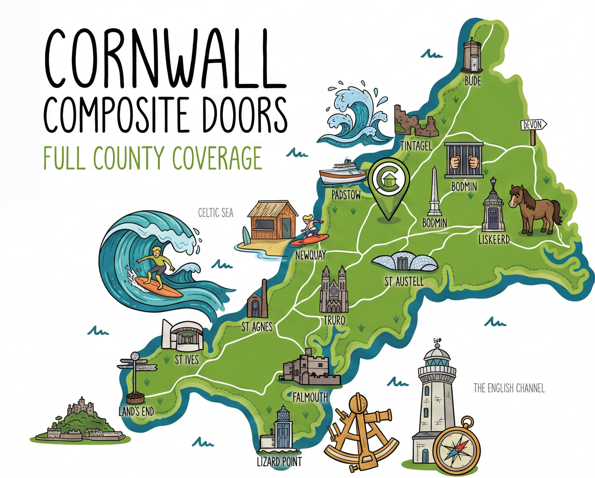
Panelled Composite Doors installed across Cornwall.
Composite Doors Truro
Truro homeowners choose composite doors for the blend of period-friendly styling and modern security their listed and Victorian properties deserve. We install across the city centre, Malpas, Highertown and the surrounding villages.
ExploreComposite Doors Falmouth
Salt air is punishing on softwood doors. Composite doors are the smart specification for Falmouth's harbourside terraces and cliff-top homes — the marine-grade skins won't warp, fade or corrode.
ExploreComposite Doors Newquay
From Pentire's holiday lets to family homes in Tretherras, our Newquay composite door installations are trusted to survive Atlantic weather while keeping the kerb appeal buyers expect.
ExploreComposite Doors St Austell
St Austell's mix of granite cottages, china-clay terraces and new-build estates means we're installing everything from Chartwell Green heritage doors to sleek anthracite grey styles.
ExploreComposite Doors Penzance
Penzance's exposed south-coast position demands doors engineered for it. Our composite installations shrug off wind-driven rain and salt spray from Mount's Bay.
ExploreComposite Doors Bodmin
Bodmin homes see everything the moor throws at them. Composite doors give the thermal efficiency and weather resistance moorland properties need.
ExploreOther traditional styles.
Panelled Composite Doors — questions answered.
Get started
Ready for a new panelled composite door?
Free, no-obligation surveys across Cornwall. Written 10-year guarantee on every install.