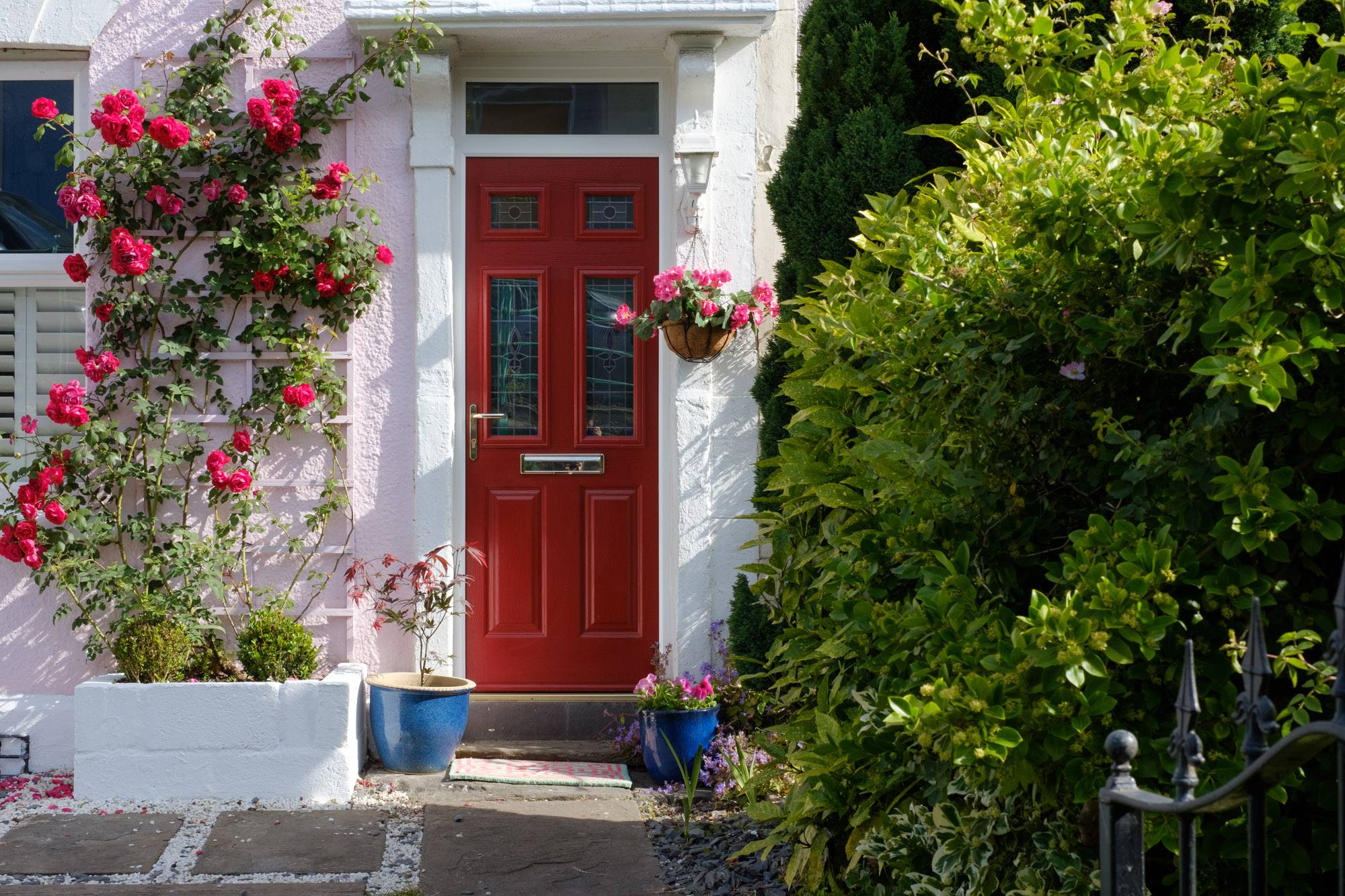
Traditional composite doors are the honest replacement for the four and six-panel timber doors that came as standard on Victorian, Edwardian and interwar Cornish housing stock. They keep the raised panel detail, the horizontal glazing rhythm and the balanced proportions that the eye expects on properties of that period — but built from a maintenance-free composite construction that will not warp, split or need repainting.
Across Cornwall, traditional composite doors are the single most-installed style on Victorian terraces in Penzance, Redruth and Camborne, on Edwardian semis in Falmouth and Truro, and on the many post-war semis that were originally fitted with timber panel doors. We install them as complete replacement units, always with PAS24:2022 accreditation, 3-star anti-snap cylinders and a 10-year written guarantee.
Typical price
£1,595–£2,195
Fully installed, 10-year guarantee
Want a quick price?
Free survey, no salesman, no obligation.
Where traditional composite doors suit.
- Victorian terraces
- Edwardian semis
- Village cottages
Traditional Composite Doors: the detail.
Design characteristics — what makes a door 'traditional'
A traditional composite door is built around raised panel detail. The six-panel arrangement — two narrow panels top, two wider centre panels, two lower panels — is the most common and the closest match to the Victorian and Edwardian originals still visible across Cornish terraces. Four-panel variants (two long uppers, two short lowers) suit interwar semis and 1930s frontages. The panels are pressed into the GRP skin at manufacture as raised mouldings, and the reading is that of a solid five-part composition rather than a single slab.
Glazing on a traditional door sits in the top two panels — either as two separate rectangular units or as a single horizontal top-light that spans the width of the door. Decorative leaded glass, bevelled clear units, sandblasted patterns and stained-effect Georgian bar arrangements all fit within the traditional idiom.
Which Cornish homes suit a traditional composite door
Traditional composite doors are the default recommendation for Victorian terraces (mid-1800s to 1901), Edwardian semis (1901–1918), interwar bay-fronted semis (1920s–1930s) and post-war terraces. Any Cornish property with sash windows, a bay window at ground floor, a decorative tiled path or an original stained-glass fanlight belongs in this category. They also suit rectory-style detached homes, small manor houses and the many 1930s to 1950s semis that ring towns like Truro, Redruth and Bodmin.
A six-panel door will look wrong on a flush new-build, a barn conversion or a genuinely modern coastal home — the raised panels create visual weight that fights the horizontal picture windows and clean rendered walls of contemporary architecture.
Security specification
Traditional composite doors carry the same PAS24:2022 accreditation, 3-star anti-snap cylinders and multi-point locking as any other style — nothing is compromised for the sake of period appearance. In fact, the heavier panel construction of a traditional door slightly improves impact resistance versus a flush slab of identical materials. Standard specification: Ultion, Brisant Sold Secure Diamond or Yale Platinum cylinder; Yale Lockmaster or ERA multi-point lock throwing three or five hooks; 8-inch reinforced hinge bolts.
Energy efficiency
A traditional composite door with two glazed upper panels typically achieves a U-value around 1.1–1.2 W/m²K. That is roughly a fifth of the heat loss of the single-panel timber door many Victorian and Edwardian Cornish homes still carry — an original timber door with no draught seals loses heat at around 3.0 W/m²K. The upgrade almost always pays back in reduced heating bills within seven to ten years on a typical Cornish four-bedroom home.
Weather resistance
The failing mode of an original timber panel door is almost always the panel joints — decades of thermal movement open microscopic gaps that eventually let driven rain into the core. A composite door has no such joints. The panels are moulded into the GRP skin, not assembled from individual timber pieces, so there is no route for water to enter. Combined with modern compression seals in the frame, this makes a traditional composite doorset genuinely weather-tight in a way that no restored timber original ever quite achieves.
Recommended heritage colours
Chartwell Green (RAL 6021), classic black, Oxford Blue, Racing Green and true whites are the traditional palette. Cornish properties overwhelmingly favour deep colours that hold up against granite and slate surrounds — sage greens and rich blacks dominate our traditional installs. Solidor and Endurance offer full RAL colour matching for conservation-area applications where a specific heritage colour has been specified by the local authority.
Glazing choices — leaded, bevelled and Georgian bar
Traditional composite doors accept a genuinely wide glazing library. Diamond and rectangular leaded units — leaded internally within the sealed double-glazed unit so no maintenance is required — are the closest match to Victorian originals. Bevelled clear glass in Georgian bar arrangements suits Edwardian and interwar properties. Sandblasted period patterns (Elizabethan, Windsor, Osborne) work where more privacy is needed. All glass is toughened to BS 6206 Class A.
Hardware — brass, antique black and chrome
Traditional composite doors almost always carry a knocker-and-knob arrangement rather than a lever handle. Antique brass, polished brass, antique black and satin chrome are the four dominant finishes. Standard specification runs a matching knocker, knob, letterplate, numerals and spy-hole. Escutcheons around the cylinder complete the reading. Yale Conexis smart locks are available in antique-brass and antique-black finishes for period installations that want keyless entry without breaking the appearance.
Frames, side panels and top-lights
Traditional doors are most often fitted in matching-colour uPVC or aluminium frames sized to the existing aperture. Side panels — where the original opening is wider than a standard door — are typically specified with a matching leaded or sandblasted decorative unit that continues the door's glazing pattern. Top-lights above the door, common on Victorian and Edwardian terraces, are almost always specified with a decorative or stained-effect unit that matches or complements the door glass.
Manufacturing
Traditional composite doors are pressed to individual order in the UK. The raised panel detail is formed by the mould tooling at the point the GRP skin is pressed onto the polyurethane core — the panels are integral to the skin, not applied afterwards. Lead-times run 4 to 6 weeks from order for standard colours; bespoke RAL colours and hand-glazed leaded units add another 1 to 2 weeks.
Maintenance
Twice-yearly cleaning with warm soapy water is all that is required. Antique brass and antique black finishes are lacquered and hold their appearance for 10 years or more; polished brass may need an occasional buff with brass cleaner if the front is south-facing. Hinges and lock keeps take a light PTFE spray once a year.
Why traditional composite doors make sense in Cornwall.
Serious security
PAS24-tested doorset with a 3-star anti-snap cylinder and multi-point locking as standard.
Warm and efficient
U-values around 1.0 W/m²K — significantly better than uPVC or hardwood alternatives.
10-year colour guarantee
UV-stabilised GRP skins that hold their colour for a decade, even on south-facing frontages.
Zero maintenance
Never needs painting. A wipe with warm soapy water twice a year is all it asks for.
Kerb appeal you notice
Bespoke colour, hardware and glass combinations designed around your property.
Installed professionally
Cornwall-based, Certass-registered fitters. Same-day install with a full cleanup.
Best colours for traditional composite doors.
Every finish carries a 10-year colour-fastness guarantee.
Design your door.
Choose your components
Compare and cost
- Composite door pricesFull price guide for Cornwall
- Composite door securityPAS24, 3-star cylinders, multi-point locks
- Installation galleryReal Cornish installations
- Frequently asked questionsThe most-asked questions
- Composite door blogGuides, comparisons and advice
- See our brandsSolidor, Endurance, Rockdoor, Comp Door
Traditional Composite Doors installed across Cornwall.
Composite Doors Truro
Truro homeowners choose composite doors for the blend of period-friendly styling and modern security their listed and Victorian properties deserve. We install across the city centre, Malpas, Highertown and the surrounding villages.
ExploreComposite Doors Falmouth
Salt air is punishing on softwood doors. Composite doors are the smart specification for Falmouth's harbourside terraces and cliff-top homes — the marine-grade skins won't warp, fade or corrode.
ExploreComposite Doors Newquay
From Pentire's holiday lets to family homes in Tretherras, our Newquay composite door installations are trusted to survive Atlantic weather while keeping the kerb appeal buyers expect.
ExploreComposite Doors St Austell
St Austell's mix of granite cottages, china-clay terraces and new-build estates means we're installing everything from Chartwell Green heritage doors to sleek anthracite grey styles.
ExploreComposite Doors Penzance
Penzance's exposed south-coast position demands doors engineered for it. Our composite installations shrug off wind-driven rain and salt spray from Mount's Bay.
ExploreComposite Doors Bodmin
Bodmin homes see everything the moor throws at them. Composite doors give the thermal efficiency and weather resistance moorland properties need.
ExploreOther traditional styles.
Traditional Composite Doors — questions answered.
Get started
Ready for a new traditional composite door?
Free, no-obligation surveys across Cornwall. Written 10-year guarantee on every install.