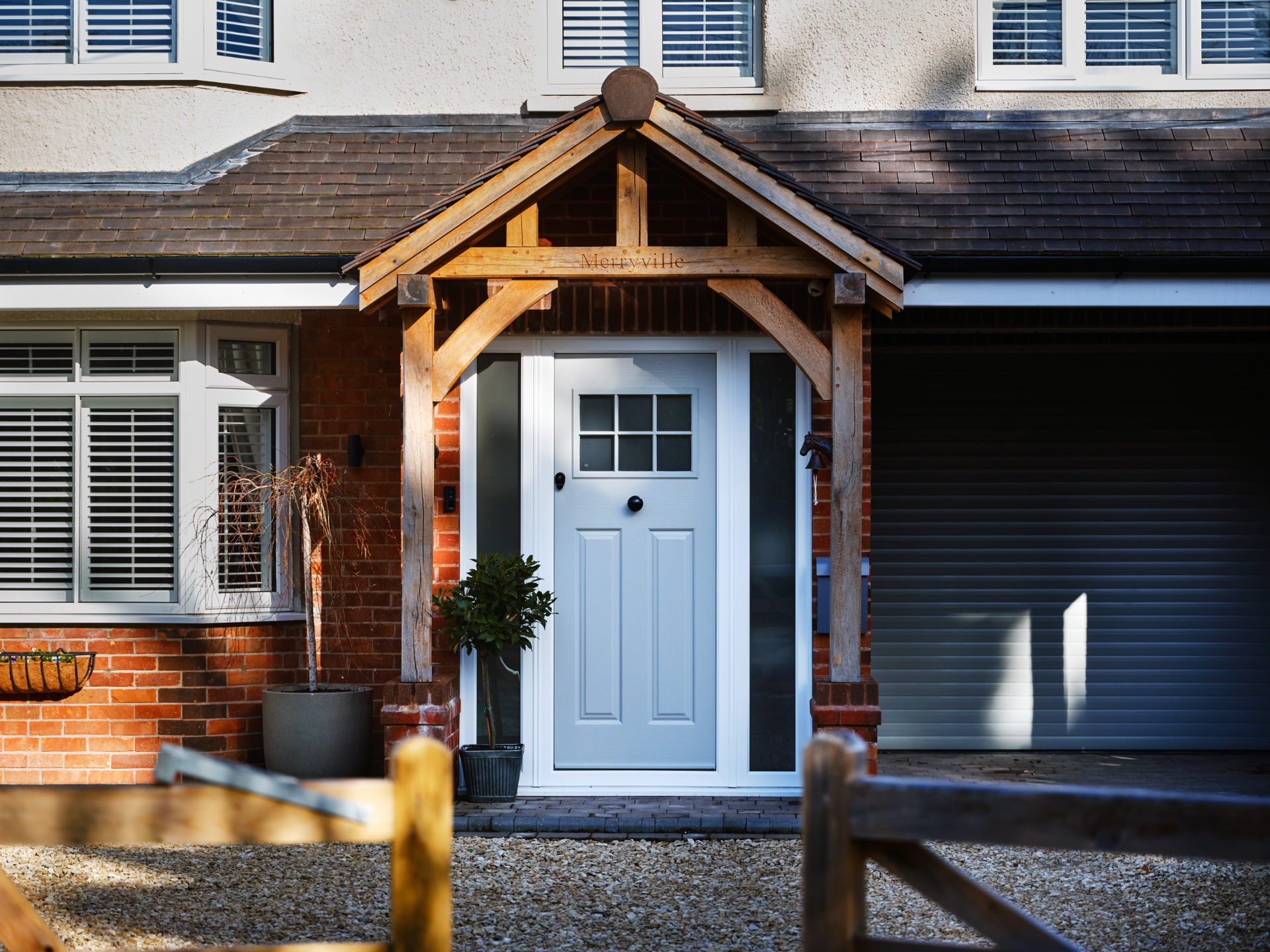
Cottage composite doors respect Cornwall's cottage vernacular — the low headers, the thick granite walls, the small window openings — while meeting modern building regulations for security, weather and energy performance. The category covers cottage-panel, stable-style and ledge-and-brace inspired designs, all built as maintenance-free composite doors that will not swell in salt-laden air the way a timber cottage door inevitably does.
We install cottage composite doors on granite cottages in Mousehole, Cadgwith, St Agnes and countless villages inland. The specification is always thought through for the property: colours from a period palette, hardware in antique black or aged brass, and glazing that reads as small-pane cottage detail rather than modern picture-window.
Typical price
£1,595–£2,195
Fully installed, 10-year guarantee
Want a quick price?
Free survey, no salesman, no obligation.
Where cottage composite doors suit.
- Granite cottages
- Fishermen's terraces
- Conservation areas
Cottage Composite Doors: the detail.
Design characteristics
A cottage composite door usually carries either a stable-style split (upper and lower halves opening independently) or a set of small square or rectangular panels arranged in a cottage layout — often four small upper panes above two solid lower panels. The face is textured woodgrain rather than smooth flush, and the colour is almost always a period sage, deep green, cream or aged white. The overall effect is a door that reads immediately as belonging to the property, not sitting on top of it.
Which Cornish homes suit a cottage door
Granite cottages from any period, whitewashed fishermen's cottages in the working harbours (Polperro, Coverack, Sennen Cove), thatched cottages inland (Blisland, Altarnun, St Mabyn), and the many small stone-built village terraces throughout the county. Barn conversions where the original character has been retained also work well with cottage-style doors, particularly stable variants that echo the original barn door arrangement.
Stable-style cottage doors
A true stable door splits horizontally at around waist height, allowing the top half to be opened for ventilation while the bottom stays closed. On a composite stable door, the two halves lock together to function as a single door when both are closed — engineered so the split does not compromise security or weather performance. Stable cottage doors are most often specified for rear kitchen entrances on Cornish farmhouses and small holdings, but front-of-house stable configurations are increasingly popular on cottage-style bed-and-breakfast properties.
Security
Cottage composite doors carry identical security specification to any other style: PAS24:2022, 3-star anti-snap cylinder, multi-point locking, reinforced hinges. Stable-configuration doors run a top-bottom shoot-bolt arrangement that locks the two halves together when the door is closed — the whole assembly then throws multi-point hooks into the frame as a single unit.
Weather and coastal specification
Cornish cottages, especially those close to the coast, face exceptional weather exposure. The compression seals in a modern cottage composite doorset achieve a genuinely weather-tight closure that no restored timber cottage door will match. For properties within a kilometre of the coast, we upgrade to marine-grade 316 stainless internal hardware and specify enhanced weather-bar profiles on the frame.
Recommended heritage colours
Sage green, Chartwell Green, duck-egg blue, aged cream, dove grey, painted white and deep red are the cottage palette. Solidor and Endurance both carry cottage-specific colour ranges (Solidor's 'Twenty20' and Endurance's traditional set) tuned to period-property expectations. All colours are colour-matched to RAL and BS4800 references so you can match the door precisely to any painted trim already on the property.
Cottage glazing patterns
Small-pane arrangements are what makes a cottage door read as cottage. Four small square panes across the top, six small rectangular panes in a two-by-three grid, or single Georgian-bar top-lights are the most common. Glass options include obscure, sandblasted, decorative leaded and stained-effect. Where the cottage originally carried coloured glass (many Cornish cottages have red or blue coloured squares), we can replicate the pattern in the sealed unit.
Hardware — antique black is the default
Antique black wrought-iron-effect hardware defines a cottage door. Ring-pull handles, T-bar handles or knob-and-knocker sets in antique black are what the eye expects. Antique brass and pewter finishes are also common. Long hinge straps (decorative, over the functional hinges) are available on cottage and stable doors to echo the strap-hinge appearance of an original ledge-and-brace door.
Frames, side panels and top-lights
Cottage doors sit best in matching-colour uPVC or aluminium frames. Because cottage apertures are often smaller and lower than modern standard sizes, we frequently specify bespoke frame dimensions — a 1900 mm door height rather than the standard 2100 mm is common on older cottages. Side panels are rare on cottage installations because cottage frontages usually cannot accommodate the extra width.
Building regulations on cottage installations
Replacement front doors on Cornish cottages usually fall under permitted development and do not require planning permission. However, cottages within conservation areas or Areas of Outstanding Natural Beauty (AONB — which covers a substantial portion of Cornwall) may face design controls. Cottages that are listed buildings will need listed building consent and typically will not be permitted composite construction. We help identify the right route before quoting.
Maintenance
Warm soapy water twice a year. Antique black finishes hold up well against Cornwall's salt air and typically remain intact for the full 10-year guarantee period. Woodgrain-effect skins clean the same as flush skins — the texture is a moulded feature of the GRP, not a coating that could wear.
Why cottage composite doors make sense in Cornwall.
Serious security
PAS24-tested doorset with a 3-star anti-snap cylinder and multi-point locking as standard.
Warm and efficient
U-values around 1.0 W/m²K — significantly better than uPVC or hardwood alternatives.
10-year colour guarantee
UV-stabilised GRP skins that hold their colour for a decade, even on south-facing frontages.
Zero maintenance
Never needs painting. A wipe with warm soapy water twice a year is all it asks for.
Kerb appeal you notice
Bespoke colour, hardware and glass combinations designed around your property.
Installed professionally
Cornwall-based, Certass-registered fitters. Same-day install with a full cleanup.
Best colours for cottage composite doors.
Every finish carries a 10-year colour-fastness guarantee.
Design your door.
Choose your components
Compare and cost
- Composite door pricesFull price guide for Cornwall
- Composite door securityPAS24, 3-star cylinders, multi-point locks
- Installation galleryReal Cornish installations
- Frequently asked questionsThe most-asked questions
- Composite door blogGuides, comparisons and advice
- See our brandsSolidor, Endurance, Rockdoor, Comp Door
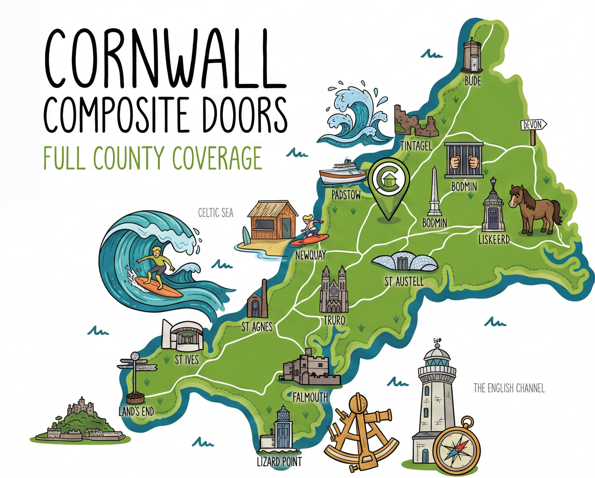
Cottage Composite Doors installed across Cornwall.
Composite Doors Truro
Truro homeowners choose composite doors for the blend of period-friendly styling and modern security their listed and Victorian properties deserve. We install across the city centre, Malpas, Highertown and the surrounding villages.
ExploreComposite Doors Falmouth
Salt air is punishing on softwood doors. Composite doors are the smart specification for Falmouth's harbourside terraces and cliff-top homes — the marine-grade skins won't warp, fade or corrode.
ExploreComposite Doors Newquay
From Pentire's holiday lets to family homes in Tretherras, our Newquay composite door installations are trusted to survive Atlantic weather while keeping the kerb appeal buyers expect.
ExploreComposite Doors St Austell
St Austell's mix of granite cottages, china-clay terraces and new-build estates means we're installing everything from Chartwell Green heritage doors to sleek anthracite grey styles.
ExploreComposite Doors Penzance
Penzance's exposed south-coast position demands doors engineered for it. Our composite installations shrug off wind-driven rain and salt spray from Mount's Bay.
ExploreComposite Doors Bodmin
Bodmin homes see everything the moor throws at them. Composite doors give the thermal efficiency and weather resistance moorland properties need.
ExploreOther cottage styles.
Cottage Composite Doors — questions answered.
Get started
Ready for a new cottage composite door?
Free, no-obligation surveys across Cornwall. Written 10-year guarantee on every install.