Arched Composite Doors
Curved top-lights and classical proportion.
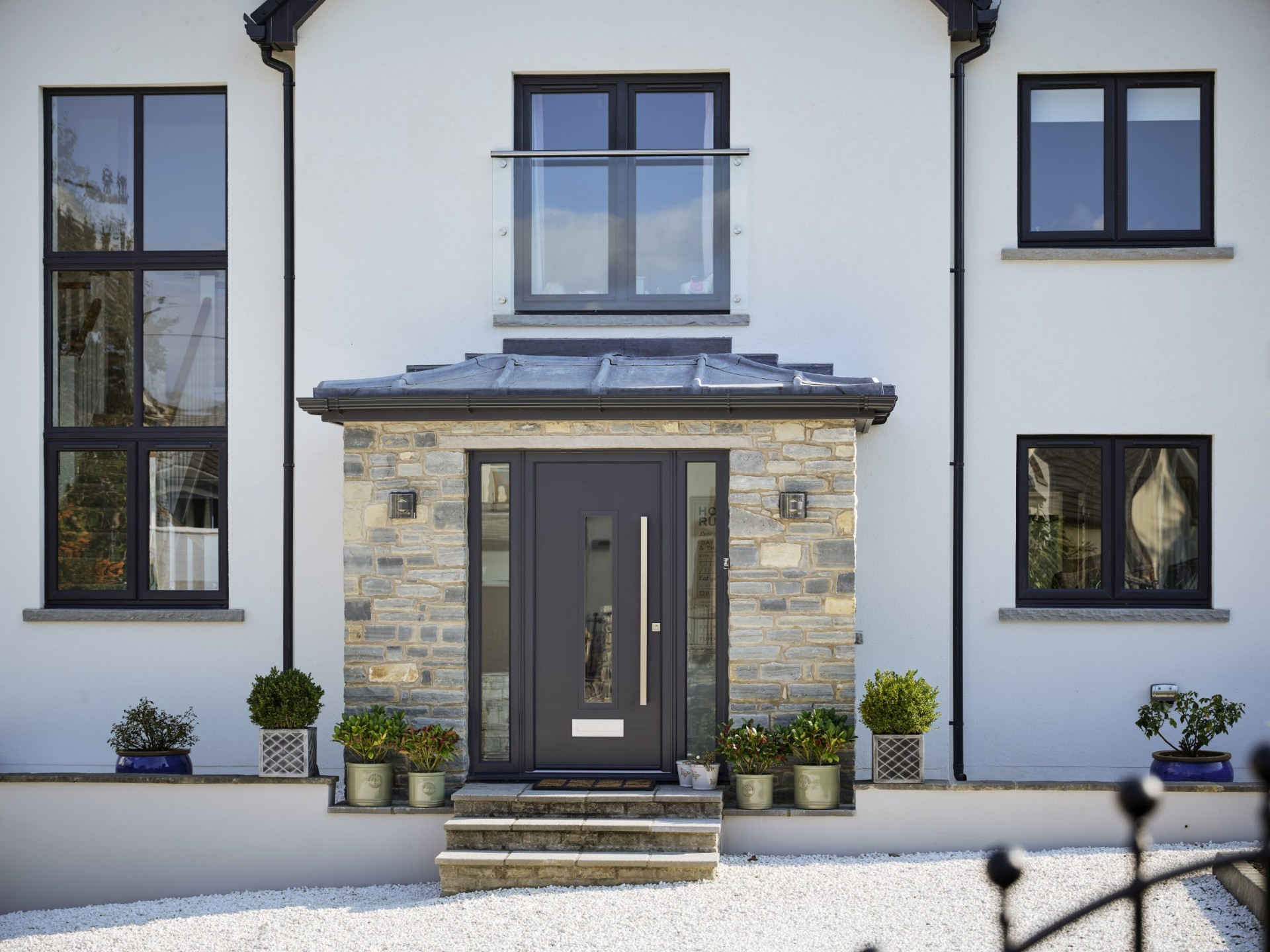
Arched composite doors carry a curved top rail or a matching arched frame top-light — the classical architectural detail that period townhouses across Truro, Falmouth and Cornwall's Victorian villages were originally built with. Arched detailing reads immediately as period-authentic and rejects the flat rectangular top that dominates modern door replacement.
We install arched composite doors as both true arched-slab doors (where the door leaf itself has a curved top rail matching the arched frame) and as flat-top doors within an arched frame top-light (where a rectangular door sits below a semicircular or segmented arched glazed transom). Both achieve the arched reading; the specification difference affects manufacturing complexity and cost.
Typical price
£2,195–£2,795
Fully installed, 10-year guarantee
Want a quick price?
Free survey, no salesman, no obligation.
Where arched composite doors suit.
- Period townhouses
- Victorian villas
- Rectory frontages
Arched Composite Doors: the detail.
True arched vs arched-top-light
A true arched composite door has a curved top rail on the door leaf itself — the top of the slab is a semicircular, segmental or Gothic arch shape. The frame matches, with a corresponding arched header. This is the more expensive specification because the door slab is manufactured to a curved profile rather than a standard rectangular one; not all manufacturers offer it. An arched-top-light installation uses a rectangular door within a wider frame that carries a fixed arched glazed transom above. Visually, both read as arched from the street; the second is significantly cheaper to specify and available from all major manufacturers.
Where arched doors work
Georgian and Victorian townhouses in Truro, Falmouth, Penzance and Fowey, Regency villas across the county, rectory-style detached homes and Cornish villages with intact Victorian streetscapes (St Just, Marazion, Charlestown). Arched doors also suit some post-war municipal architecture (schools, chapels, community halls) that carried arched entrance detailing.
Arch shapes
Semicircular (a true half-circle from spring point to spring point at the door head) is the classical Georgian and Regency arch. Segmental (a shallow arc, less than a half-circle) is more common on Victorian domestic architecture. Gothic (a pointed arch) is rare on domestic properties but common on chapels and some Victorian villas. Elliptical (a slightly flattened arc) suits Regency and early Victorian properties.
Glazing on arched doors
The upper section of a true arched door is usually glazed to follow the arched profile — a decorative leaded arch-shaped panel is the most common specification. Georgian-bar patterns radiate from the arch centre in a sunburst or spider arrangement. On arched-top-light installations, the glazed transom above the door usually carries decorative leaded or Georgian-bar glazing.
Colour
Deep heritage colours suit arched doors — black, Chartwell Green, Oxford blue and Ox-blood red. The arch is enough of a decorative statement that bold colours would compete with the architecture rather than complement it. Painted whites and cream also work on Regency and Georgian townhouses.
Security
Standard PAS24:2022, 3-star anti-snap cylinder, multi-point locking. True arched slabs carry the same security specification as rectangular slabs — the curved top rail does not compromise the lock arrangement, which is always mounted along the vertical stile.
Hardware
Polished brass or aged brass hardware is standard on arched installations. Lion's-head knockers, urn-pattern letterplates, ceramic-centred numerals and matching brass escutcheons. The scale of hardware is usually generous on arched doors — the arched shape reads as architectural, so understated hardware would feel disproportionate.
Frame considerations
True arched doors require a matching arched frame with a curved header profile — manufactured as a single one-piece unit rather than mitred at the corners. Aluminium frames handle the curve better than uPVC. Where the existing aperture is rectangular but the specification is arched, an arched-top-light installation is typically cheaper than modifying the aperture to accept a true arched slab.
Cost and lead-time
True arched slabs: £2,495 to £3,595 fully installed, 8 to 10 weeks manufacturing lead-time. Arched-top-light installations (rectangular door plus arched transom): £2,195 to £2,995 fully installed, 6 to 7 weeks manufacturing lead-time. Fully bespoke Gothic or elliptical arches: quote-on-request.
Conservation and listed buildings
Arched doors are almost always period-appropriate specifications that gain conservation approval readily. Grade II listed buildings sometimes accept composite arched doors where the specification matches the original; Grade II* and Grade I typically require timber.
Why arched composite doors make sense in Cornwall.
Serious security
PAS24-tested doorset with a 3-star anti-snap cylinder and multi-point locking as standard.
Warm and efficient
U-values around 1.0 W/m²K — significantly better than uPVC or hardwood alternatives.
10-year colour guarantee
UV-stabilised GRP skins that hold their colour for a decade, even on south-facing frontages.
Zero maintenance
Never needs painting. A wipe with warm soapy water twice a year is all it asks for.
Kerb appeal you notice
Bespoke colour, hardware and glass combinations designed around your property.
Installed professionally
Cornwall-based, Certass-registered fitters. Same-day install with a full cleanup.
Best colours for arched composite doors.
Every finish carries a 10-year colour-fastness guarantee.
Design your door.
Choose your components
Compare and cost
- Composite door pricesFull price guide for Cornwall
- Composite door securityPAS24, 3-star cylinders, multi-point locks
- Installation galleryReal Cornish installations
- Frequently asked questionsThe most-asked questions
- Composite door blogGuides, comparisons and advice
- See our brandsSolidor, Endurance, Rockdoor, Comp Door
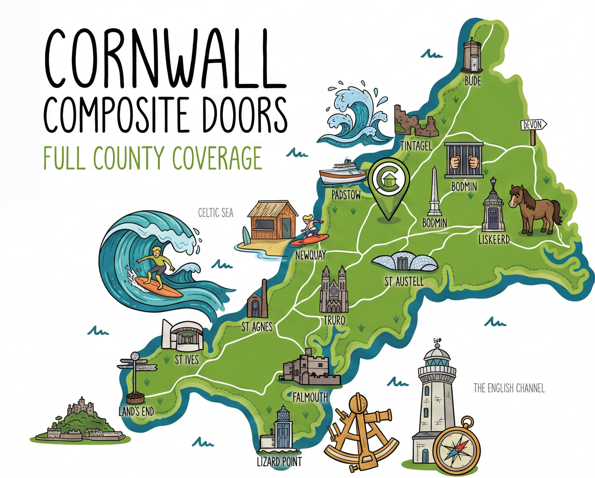
Arched Composite Doors installed across Cornwall.
Composite Doors Truro
Truro homeowners choose composite doors for the blend of period-friendly styling and modern security their listed and Victorian properties deserve. We install across the city centre, Malpas, Highertown and the surrounding villages.
ExploreComposite Doors Falmouth
Salt air is punishing on softwood doors. Composite doors are the smart specification for Falmouth's harbourside terraces and cliff-top homes — the marine-grade skins won't warp, fade or corrode.
ExploreComposite Doors Newquay
From Pentire's holiday lets to family homes in Tretherras, our Newquay composite door installations are trusted to survive Atlantic weather while keeping the kerb appeal buyers expect.
ExploreComposite Doors St Austell
St Austell's mix of granite cottages, china-clay terraces and new-build estates means we're installing everything from Chartwell Green heritage doors to sleek anthracite grey styles.
ExploreComposite Doors Penzance
Penzance's exposed south-coast position demands doors engineered for it. Our composite installations shrug off wind-driven rain and salt spray from Mount's Bay.
ExploreComposite Doors Bodmin
Bodmin homes see everything the moor throws at them. Composite doors give the thermal efficiency and weather resistance moorland properties need.
ExploreArched Composite Doors — questions answered.
Get started
Ready for a new arched composite door?
Free, no-obligation surveys across Cornwall. Written 10-year guarantee on every install.