Quick answer
Composite doors built to PAS 24:2022 and fitted with a TS007 3-star cylinder are among the most attack-resistant front doors available to UK homeowners, combining a 44-48mm engineered timber core, a multi-point locking mechanism and an impact-resistant GRP skin. Real-world security depends as much on correct installation and lock spec as on the door itself.
Overview
A modern composite door combines a 44mm timber-core slab, a GRP outer skin that resists cutting and impact, a multi-point locking mechanism engaging 5-7 points down the door edge, and a 3-star anti-snap cylinder. Independently tested to PAS24:2022, they're specified by police-approved Secured by Design schemes and required by many new-build warranties.
Why the construction matters more than the finish
A composite door slab is built up in layers: a timber or insulated foam core for rigidity, a GRP (glass-reinforced plastic) or composite skin bonded under heat and pressure, and a steel reinforced frame around the lock and hinge lines. That layered construction is what gives it genuine resistance to cutting, drilling and impact, not just a decorative finish that photographs well.
Compare that to a hollow uPVC door, which relies on internal plastic webbing rather than a solid core, or a traditional timber door, which can split along the grain under a well-aimed kick. The composite build spreads load rather than concentrating it at one weak point.
The role of PAS 24:2022 testing
PAS 24 is the Publicly Available Specification that UK doorsets are tested against for enhanced security performance. The 2022 revision tightened requirements compared with the 2016 version, including how manual and mechanical attack tests are applied to the whole doorset, not just the leaf. A door carrying a genuine PAS 24:2022 certificate has been physically attacked by trained testers using tools comparable to what an opportunist burglar might carry, for a defined period, and has resisted entry.
It's worth noting PAS 24 tests the doorset as installed - the door, frame, glazing and ironmongery together - which is one reason a poorly fitted PAS 24-rated door doesn't automatically inherit the same real-world performance as the one on the test bench.
Locking mechanism: the working part of the security
Most residential composite doors use a 5-point mechanism - a mix of hooks, deadbolts and anti-lift rollers - driven by a single handle lift. Higher-spec doors use 7 points, adding extra hooks for taller leaves or higher security ratings. Every point needs to engage for the rated security to apply; a mechanism with one seized hook is functioning at a fraction of its design strength.
- Hooks - draw the door tight into the frame and resist prising
- Deadbolts - locked by the cylinder, resist sawing
- Anti-lift rollers - stop the door being jemmied upward off its hinges
Cylinder security: where most break-ins actually happen
Lock snapping - applying leverage to break a euro cylinder at its narrowest point - became the dominant forced-entry method against uPVC and composite doors through the 2010s, precisely because older cylinders had a weak point roughly level with the door edge. TS007 3-star cylinders (or 1-star cylinders paired with a 2-star handle) are designed with sacrificial sections and anti-drill, anti-pick and anti-bump features that defeat this attack.
If you take one fact away from any composite door security guide, it should be this: the door slab is rarely the weak point in a modern forced entry attempt. The cylinder almost always is.
How Cornwall's coastal exposure changes the picture
Salt air and driving rain don't make a door less secure in a mechanical sense, but they accelerate wear on the moving parts - hinges, gearbox springs, cylinder pins - that keep the mechanism performing at its rated strength. A 3-star cylinder that's seized solid from corrosion is not offering 3-star protection; it's offering none, because nobody can lock the door properly.
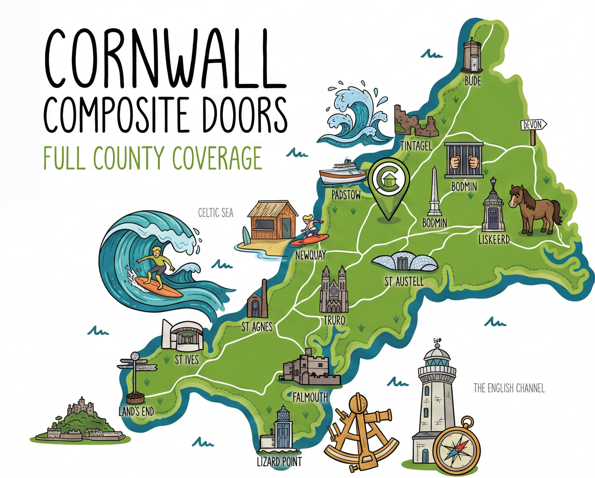
This is why we recommend slightly shorter service intervals for properties within a mile or so of the sea, particularly on exposed stretches of coast from Bude round to Falmouth and along the Lizard.
What 'secure' means in practical, insurable terms
Most UK home insurers now expect a five-lever mortice lock or multi-point locking system meeting BS 3621 or equivalent on final exit doors as a minimum condition of cover. A composite door with a working multi-point mechanism and a kitemarked cylinder comfortably clears that bar, and upgrading to a 3-star anti-snap cylinder is a small additional cost that some insurers reward with a modest premium reduction.
When to call a professional
- For a security upgrade audit.
Prevention
- Choose PAS24:2022 as your minimum spec.
- Combine with a Secured by Design letterplate and viewer.