Quick answer
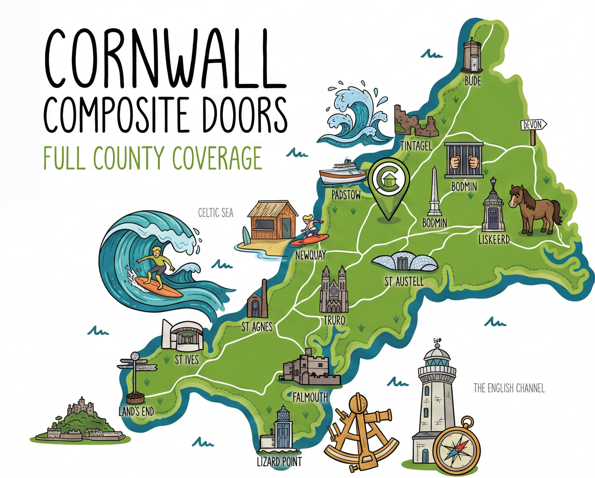
Emergency composite door situations include being locked out, break-in or forced-entry damage, a lock or mechanism failure that stops the door securing, and broken glazing. Cornwall Composite Doors offers same-day and next-day emergency callouts across the county, from Bude to Land's End, prioritising anything that leaves a property insecure.
Overview
Emergencies: locked out, broken lock, forced entry damage, broken glass. Cornwall Composite Doors offers same-day and next-day emergency callouts across the county.
Symptoms
- Locked out.
- Break-in.
- Lock or door mechanism failure preventing secure closure.
- Broken glazing.
Common causes
- Various - but security is the priority.
What actually counts as an emergency
Not every door problem needs an emergency response, and it's worth understanding the difference so you can make the right call under pressure. A genuine emergency is anything that means the property cannot be properly secured — a lock that won't engage at all, a door forced open during an attempted break-in, glazing broken out entirely, or being locked out of a property with no other means of secure entry.
A door that's stiff, slow, or needs extra effort to lock is inconvenient but not an emergency in the same sense — it can typically wait for a standard appointment. Knowing this distinction helps you prioritise correctly and also helps us get to genuine emergencies faster by not queuing behind non-urgent work.
Being locked out
A lockout can happen for several reasons — a snapped key, a seized cylinder, a lost key with no spare, or a multi-point mechanism that's jammed mid-cycle. The right response depends on the cause: a snapped key sometimes leaves enough of the mechanism intact for a locksmith-style extraction, while a fully seized or jammed mechanism may need the cylinder or gearbox accessed and replaced to regain entry without damaging the door.
We assess the specific failure before attempting entry, because the wrong method can cause more damage to the door and frame than necessary, adding cost and repair time on top of the original problem.
Break-in and forced-entry damage
After a break-in attempt, whether successful or not, the priority is making the property secure again as quickly as possible — this usually means assessing whether the frame, keeps, lock and door slab are still structurally sound enough to secure temporarily, or whether a board-up is needed while a proper repair is arranged. Forced entry commonly damages keeps, splits frame sections near the lock, and can compromise the multi-point mechanism even where the door itself looks largely intact.
We work with what insurance processes typically require, including photographing damage before repair work begins, which is worth mentioning to us at the point of booking if you'll be making a claim.
Lock and mechanism failures that compromise security
A multi-point lock that won't fully engage — even if the door appears closed — means the property isn't properly secured, since most of the security benefit of a composite door comes from multiple locking points along the frame, not just the handle. This kind of failure can develop gradually (worsening over weeks) or suddenly (a gearbox failing outright), and either way it needs prompt attention rather than being left overnight.
In the interim, if a door won't lock securely and a same-day repair isn't available, additional temporary security measures (a supplementary lock, or in worst cases boarding) are worth discussing with us over the phone before we arrive.
Broken glazing
Broken glass in a composite door's glazed panel is both a security gap and, depending on size and location, a safety hazard from broken edges. Most composite door glazing is toughened or laminated safety glass, which behaves differently when broken — laminated units tend to crack and hold together while toughened units can shatter into small granular pieces — and the repair approach differs accordingly. Emergency response typically involves securing the opening safely first, with a proper glazed unit replacement to follow once measurements and stock are confirmed.
Coverage across Cornwall and response times
We cover the whole county end to end — from Bude in the north down to Land's End and along both coasts — with same-day response wherever possible for genuine emergencies, and next-day as the fallback where same-day isn't achievable due to distance or existing workload. Holiday-let and second-home owners calling from outside the county can rely on us to coordinate directly with a keyholder or agent on-site, which is often necessary since the owner isn't locally available.
When you call, being clear about whether the property is currently secure or not helps us prioritise correctly — an insecure property always takes precedence over a stiff lock, however urgent the latter might feel to live with.
Your rights when an emergency call-out goes wrong
Emergency work commands a premium, but it doesn't exempt the tradesperson from the same Consumer Rights Act 2015 standard of reasonable care and skill as any other job. Get a written invoice detailing exactly what was done, and if a rushed emergency fix fails again within days, that's grounds to ask for it to be put right at no extra charge rather than paying twice for the same repair.
Where possible, ask for an approximate cost before work starts even in an emergency — reputable emergency call-out services can usually give a sensible range over the phone based on a description of the fault.
What emergency call-outs typically cost
Emergency securing of a door that won't lock or has been forced typically costs £90–£180 for the call-out plus parts, with evening, weekend or same-day premiums on top of standard hours pricing. A temporary secure-and-return visit, where we make the property safe and return in normal hours for a full repair, is often cheaper overall than insisting on a complete fix at midnight.
Full multi-point lock replacement as part of an emergency visit runs £120–£220 in parts and labour, broadly in line with a non-emergency repair once the call-out premium is accounted for separately.
Second homes and absent owners: coordinating emergencies remotely
Emergency door failures on unoccupied second homes are a particular concern because an insecure property can sit unattended for days if there's no local contact. We work directly with letting agents, neighbours or keyholders for these jobs and can send photo confirmation the moment the property is secured, which matters most when the owner is hours or even a flight away and can't check for themselves.
Servicing to reduce the chance of a genuine emergency
Most emergency call-outs trace back to a fault that had been developing for weeks — a stiffening lock, a hinge working loose, a seal that had already started failing — rather than sudden failure out of nowhere. An annual service check on exposed coastal properties, or every 18–24 months for sheltered inland ones, catches most of these before they become a lock-out or a security emergency.
A decision framework for out-of-hours call-outs
If the door won't lock but the property is otherwise secure (leaf closed, frame intact), a same-day rather than immediate call-out is usually adequate. If the door won't close at all, has been forced, or a lock has failed leaving the leaf loose in the frame, that's a genuine emergency worth paying the premium for. If it's a second home and no one's on site, the priority is making the opening secure first and scheduling the proper repair separately, which is almost always cheaper than insisting on both in one out-of-hours visit.
Typical repair costs in Cornwall
| Work | Typical price | Notes |
|---|---|---|
| Emergency callout (same-day, within hours) | £95–£150 | Callout fee, work quoted separately |
| Lock/cylinder emergency replacement | £120–£220 | Includes callout |
| Temporary board-up (break-in) | £75–£150 | While permanent repair is arranged |
| Emergency glazing unit replacement | £180–£320 | Subject to glass type and size |
Guide prices only — we confirm the cost after seeing the door.
When to call a professional
- Immediately for any door that won't secure.
Prevention
- Annual servicing.